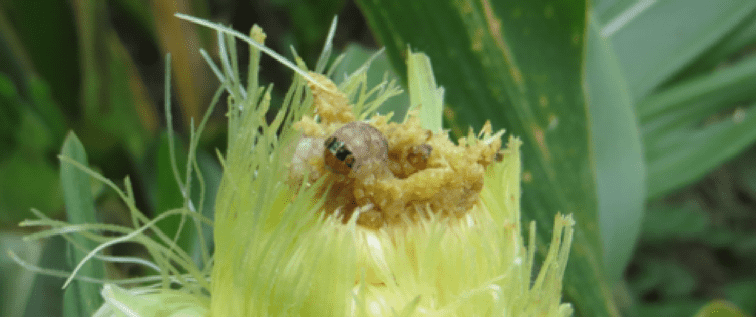
How well do you know the common, yield-robbing pests in your area? The Amplifier shares signs of infestation and management tips for controlling agriculture’s most costly pests. To kick off our series, we look at a common pest that is recognizable by masses of up to 200 eggs that, once hatched, will devour developing kernels, thus reducing grain quality and corn yields: western bean cutworm.
Western bean cutworm is native to North America and, while populations vary from year to year, it poses a severe threat to some growing regions of the Corn Belt.
“It’s really a prolific pest, capable of spreading across the Corn Belt quickly and often in multiple waves each growing season,” warns Todd McRoberts, NK Seeds Agronomy Manager. “Farmers need to recognize the signs of western bean cutworm in order to treat it early and effectively, before it invades their corn plants and threatens their profit potential.”
Egg masses are flat and irregularly shaped, with each individual egg measuring about the size of a pinhead. While these masses can be as large as 200 eggs, they more commonly consist of 15-30 eggs, typically located in the upper plant leaves, which mature quickly and darken in color as they do.
Once hatched, young WBC larvae feed primarily on pollen within the tassels, but they eventually move down into developing silks. After pollination is complete, these pests quickly move inside the ear husk to feed on developing kernels. (You may spot holes in husks where they’ve entered and exited ears.) In doing so, they not only reduce grain quality and yield potential, but also leave the plant more susceptible to molds and dangerous mycotoxins.
Managing Western Bean Cutworm
Given the speed at which WBC can invade a corn husk, and the extent of the damage it can cause, it’s important to treat crops for this destructive pest early. Unfortunately, timing foliar insecticides to control WBC can be challenging, since the pests feed outside the husk for only a short period of time. Once they move inside, they become much more difficult to control.
“Treatment should be targeted for as soon as egg hatch begins,” advises McRoberts. “It’s therefore imperative to scout crops and to choose trait stacks like DuracadeViptera, which is the best option on the market to consistently limit western bean cutworm damage and protect grain quality.”
McRoberts says that farmers have multiple scouting options available, including setting pheromone traps, using degree days to predict moth emergence, setting black light traps and scouting corn plants in at least 20 consecutive plants at five locations of the field, inspecting the upper surface of leaves within the upper third of the plan for egg masses. He says that regular scouting and early treatment are essential to keeping WBC in check.
To learn more about controlling WBC, contact your local agronomist.
Look for more seasonal agronomic tips here on The Amplifier throughout the growing season.
All photos are either the property of Syngenta or are used with permission.
© 2022 Syngenta. NK®, DuracadeViptera™ and the Syngenta logo are trademarks of a Syngenta Group Company. All other trademarks are the property of their respective third-party owners.