From a cold, wet spring that forced a late planting to June storms that left many Midwestern farmers assessing hail damage, the 2022 growing season got off to a bumpy start across much of the Corn Belt. Fortunately, farmers are resilient by nature, and with a few adjustments to their soybean management practices, NK Seeds soybean experts say that there’s reason for optimism for the season ahead.
Early-Summer Soybean Management Tips
for the 2022 Growing Season
- When it comes to early-season diseases, look at your crop stage, not your calendar.
“Farmers are accustomed to addressing issues like Phytophthora Root Rot and Pythium in the spring, but given this season’s delayed planting, there are issues that need to remain on farmers’ radars this June,” says Eric Miller, NK Seeds Soybean Product Manager. This time of year, Phytophthora can be more challenging to identify, since its symptoms (wilted or dying leaves) mimic the effects of drought. Pythium is also a risk this year since a primary causation of the soil fungus is cool, wet soil.
While these spring yield robbers can be treated with seed treatments and fungicides, respectively, Miller encourages farmers to consider varieties with stacked Rps1c/3a or Rps1k/3a genes to protect from them. “Seed selection is one of the best tools in their toolbelts,” he says. “Products like NK14-W6E3, NK29-Z4E3 and NK31-M7E3 have defense mechanisms built into their genetics to get soybeans off to a strong and vigorous start.”
- Scout and treat for pests like soybean cyst nematode now to prevent late-season disease.
Soybean cyst nematodes tend to make their move early in the growing season, as they burrow into the plant and move through the roots. “Aside from the obvious damage this pest causes by weakening the plant roots, they also provide an entry point for later-season agronomic issues like Sudden Death Syndrome,” warns Todd McRoberts, NK Seeds Agronomy Manager.
“Fortunately, products like NK14-W6E3 and NK19-T8E3S feature Peking soybean cyst nematode protection, which in turn offers solid standability.” For fields with a history of soybean cyst nematode and Sudden Death Syndrome, McRoberts advises farmers to also consider seed treatments like Saltro®.
- Carefully consider replant decisions necessitated by poor emergence, hail damage or other weather incidents.
“Some Midwest farmers have already had to contend with hail damage this year, and they’ll want to look at defoliation as a measurement of damage,” says McRoberts. “While leaf loss may have little impact on yield potential, it can cause significant damage in later reproductive stages.”
Before making any soybean replanting decisions, farmers will also want to evaluate plant health, determine their remaining stand and compare the yield potential of a reduced stand to a replanted stand. NK Seeds offers tables in the NK Seeds Agronomic Guide, available for free from NK sales representatives, to help farmers calculate these factors based on harvest population, planting date and plant stand assessment. Finally, adjust seeding rate and row spacing for late-planted crops. Miller suggests increasing seeding rate by 5%-10%, as a general rule of thumb, and reducing row width from 30 to 15 inches when possible.
- Control weeds early.
With planting complete, it’s time to focus on early-season weed control — before weeds exceed four inches in height. Look for products like NK20-B6E3S, NK33-W2E3S and NK37-V4E3S, which feature proprietary genetics stacked on Enlist® E3 herbicide traits, and consider in-season applications of 2,4-D and glufosinate as needed.
- Document observations and capture early-season data.
There are many data points to be noted in the first weeks of the season, from how vigorously crops emerge from the ground to how they stand and tolerate disease pressure. “The evaluation process for next season should begin long before harvest; it should begin during emergence,” urges Miller. “There’s a lot to be learned during soybean emergence and the critical weeks that follow.”
For more information on these or any other NK corn and soybean products, contact your local NK sales representative or consult the 2022 NK Seed Guide.
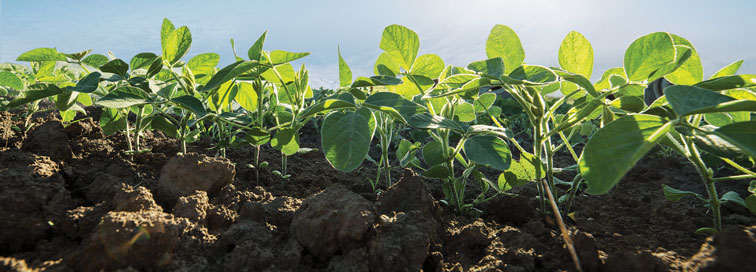
All photos are either the property of Syngenta or are used with permission.
© 2022 Syngenta. Important: Always read and follow label and bag tag instructions; only those labeled as tolerant to glufosinate may be sprayed with glufosinate ammonium-based herbicides.
LibertyLink®, Liberty® and the Water Droplet logo are registered trademarks of BASF. HERCULEX® and the HERCULEX Shield are trademarks of Corteva Agriscience LLC. HERCULEX Insect Protection technology by Corteva Agriscience LLC.
Under federal and local laws, only dicamba-containing herbicides registered for use on dicamba-tolerant varieties may be applied. See product labels for details and tank mix partners. Golden Harvest® and NK® soybean varieties are protected under granted or pending U.S. variety patents and other intellectual property rights, regardless of the trait(s) within the seed. The Enlist E3® soybean, LibertyLink®, LibertyLink® GT27®, Roundup Ready 2 Xtend®, Roundup Ready 2 Yield® and XtendFlex® soybean traits may be protected under numerous United States patents. It is unlawful to save soybeans containing these traits for planting or transfer to others for use as a planting seed. Only dicamba formulations that employ VaporGrip® Technology are approved for use with Roundup Ready 2 Xtend® and XtendFlex® soybeans. Only 2,4-D choline formulations with Colex-D® Technology are approved for use with Enlist E3® soybeans. The trademarks or service marks displayed or otherwise used herein are the property of a Syngenta Group Company. ENLIST E3® soybean technology is jointly developed with Corteva Agriscience LLC and M.S. Technologies, L.L.C. The ENLIST trait and ENLIST Weed Control System are technologies owned and developed by Corteva Agriscience LLC. ENLIST® and ENLIST E3® are trademarks of Corteva Agriscience LLC. GT27® is a trademark of M.S. Technologies, L.L.C. and BASF. Roundup Ready 2 Xtend®, Roundup Ready 2 Yield®, XtendFlex® and YieldGard VT Pro® are registered trademarks used under license from the Bayer Group.
All other trademarks are the property of their respective owners.